

What is “Financial Analysis” and why it can help your business grow?
Running a horse business isn’t just about keeping the barn doors open — it’s about building a sustainable operation that thrives year after year. While accurate bookkeeping is essential, the real power lies in analysis and advisory services. These proactive tools transform your financial data into actionable strategies, helping you grow revenue, cut costs, and maximize your return on investment (ROI).
Why Analysis Is the Game-Changer
Numbers tell a story: Every invoice, payroll, and expense reflects the health of your business. Analysis uncovers patterns in cash flow, profitability, and seasonal trends.
Proactive decision-making: Instead of reacting to financial surprises, analysis equips you to anticipate challenges and seize opportunities.
Clarity in complexity: Horse businesses juggle unique income streams — boarding, training, breeding, lessons, shows. Analysis helps you see which areas are most profitable and where adjustments are needed.
Advisory Services: Turning Insight Into ROI
Strategic planning: Advisory services translate financial insights into growth strategies, whether it’s expanding boarding capacity or adjusting lesson pricing.
Cost control: Identifying inefficiencies in feed, labor, or facility maintenance can save thousands annually.
Revenue optimization: Advisory guidance helps you refine services, target the right clients, and price competitively.
Measurable ROI: Every dollar spent on advisory services is an investment in smarter decisions, stronger margins, and long-term stability.
Real-World Impact
Imagine this:
A barn owner discovers through analysis that boarding generates steady income but lessons deliver higher margins. With advisory guidance, they shift focus to expanding lesson programs — resulting in a 15% increase in annual profit.
A breeder identifies rising feed costs as a drain on cash flow. Advisory services recommend bulk purchasing and supplier renegotiation, saving $10,000 per year.
These aren’t just numbers — they’re proof that proactive financial management pays off.
Why Choose The Equine Bookkeeper
At The Equine Bookkeeper, LLC, we don’t just balance your books. We provide the analysis and advisory services that empower horse business owners to make confident, profitable decisions. With decades of equine and accounting expertise, we understand your industry inside and out — and we know how to turn financial data into growth strategies.
Top Pain Points for Horse Businesses (and Why They Matter)
1. Financial Management & Bookkeeping
Messy or inconsistent books
Hard for owners to track profitability, cash flow, or expenses by horse/client.Unclear cost of care
Many barns don't know true costs per stall, per service, or per horse.Delayed invoicing / missed charges
Extras like meds, supplements, training rides, or haul-ins often go unbilled.No separation of business vs. personal expenses
Leads to tax headaches and inaccurate financials.Tax-time panic
Lack of clean records for deductions, depreciation (trailers, tractors, arenas), or 1099s.
2. Client Management & Billing
Late payments / unpaid board bills
Horse businesses often rely on handwritten notes or texts for billing.Disputes due to unclear contracts or itemized charges
Owners forget what’s included vs. extra.Manual, inconsistent invoicing systems
Creates errors and lost revenue.Lack of automatic reminders
Leads to chronic delinquent accounts.
3. Payroll & Staffing
Classification issues (employee vs. contractor)
High audit risk—especially with grooms, trainers, and working students.High employee turnover
Due to low wages, long hours, and unclear management.Tracking hours for barn staff
Many barns still use pen & paper.
4. Operations & Compliance
Liability risk
Missing waivers, outdated boarding contracts, or no medical release forms.Zoning or land-use compliance
Manure management plans, setback requirements, and permitted use issues.Insurance complexities
Care, custody & control (CCC), mortality policies, training liability.
5. Inventory & Cost Control
Feed and bedding waste
No tracking → higher costs.Supplement & medication tracking
Easy to lose track of what’s billed vs. given.Equipment and tack depreciation
Not tracked, leading to loss of deductible value.
6. Cash Flow & Profitability
Seasonal fluctuation
Show barns and breeders especially struggle with predictable cash flow.Expensive capital improvements
Arenas, fencing, footing, tractors, barns → big investments requiring planning.Thin profit margins
Many boarding barns barely break even.
7. Scheduling & Resource Management
Arena conflicts
Trainers vs. boarders, riding lessons vs. schooling.Overbooked or underbooked service providers
Farriers, vets, and chiropractors need predictable schedules.Hauling coordination
Multiple horses going to the same show or vet trip.
8. Communication Breakdowns
Text-message chaos
Instructions for care, supplements, turnout, or training get lost.No centralized system for updates
Leading to misunderstandings with clients.After-hours client messages
Burnout for barn owners and trainers.
9. Technology Gaps
Still using paper binders and whiteboards
For health records, stall assignments, feeding plans.No digital bookkeeping systems
Difficult to scale or share information.No dashboards or analytics
Decisions are based on “gut feeling.”
10. Compliance & Recordkeeping
Vaccinations, deworming, farrier schedule tracking
Missed reminders can create health and liability issues.Show records, registration, and paperwork
Often disorganized or inaccurate.Worker comp / OSHA compliance
Especially important for large barns.
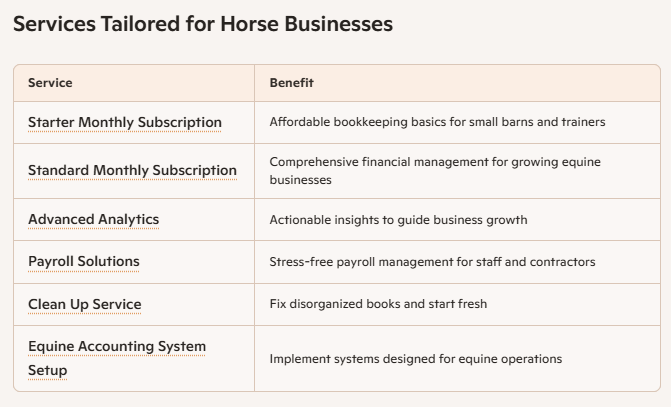
Pain Points We Can Directly Solve:
Clean up messy books
Track profitability by horse or service
Automate invoicing and collections
Handle 1099s, payroll, and compliance
Build custom dashboards
Provide CFO-level insight
Ensure tax-ready books
Reduce lost revenue from missed billables
The Result:
✔️ Predictable cash flow
✔️ Less stress
✔️ Clear financial insight
✔️ Time to spend on horses, not paperwork
✔️ Someone who understands the horse-industry particulars
